

with Painted Snipes, Cape Penduline Tits, Sengis and Ground Squirrels in the south of Namibia
We are only a few days into our current nature safari, where the colourful oil beetle (Meloidae) is discussed just as much as the various grasses, birds and mammals, and … something is stirring inside me.
My guests are not just birders, they can teach me all sorts of things about mint-family plants (Lamiaceae) and beetles. I then competently take care of the flora, bird and mammal part; one has to be good for something, after all.
So far we have been able to experience – at this expression a lady next to me gasped a little – two ornithological orgasms. It is quite simple: if you see a very special, rare bird that is difficult to find and, if things go well, is even outside its normal range, this wonderful excitement spreads, that natural bliss which many nature lovers rave about.


The Painted Snipe did not show up entirely unexpectedly. It had rained a little and I figured that one or another male had already flown off on its wanderings and got lost onto the LeafLove conservancy.
Quote from the German Wikipedia: “Polyandry (from Ancient Greek polyandría, German ‘wealth of men’ or ‘Vielmännerei’) is a form of polygamy in which a woman is married to more than one husband. In the case of two men the term biandry is also used. The counterpart is polygyny (‘Vielweiberei’).”
Painted Snipes are polyandrous. Since we had already been able to find at least 3 successful families last year, a repeat was hardly in sight after this little rain … far from it! We saw a total of 6 females! What luck, because surely the males are already sitting on the eggs and we can soon look forward to the chicks … as long as the confounded baboons don’t turn up and ruin everything.
I’ll let you know, but one thing is certain: we have definitely done a lot right with the nature conservation on our farm!
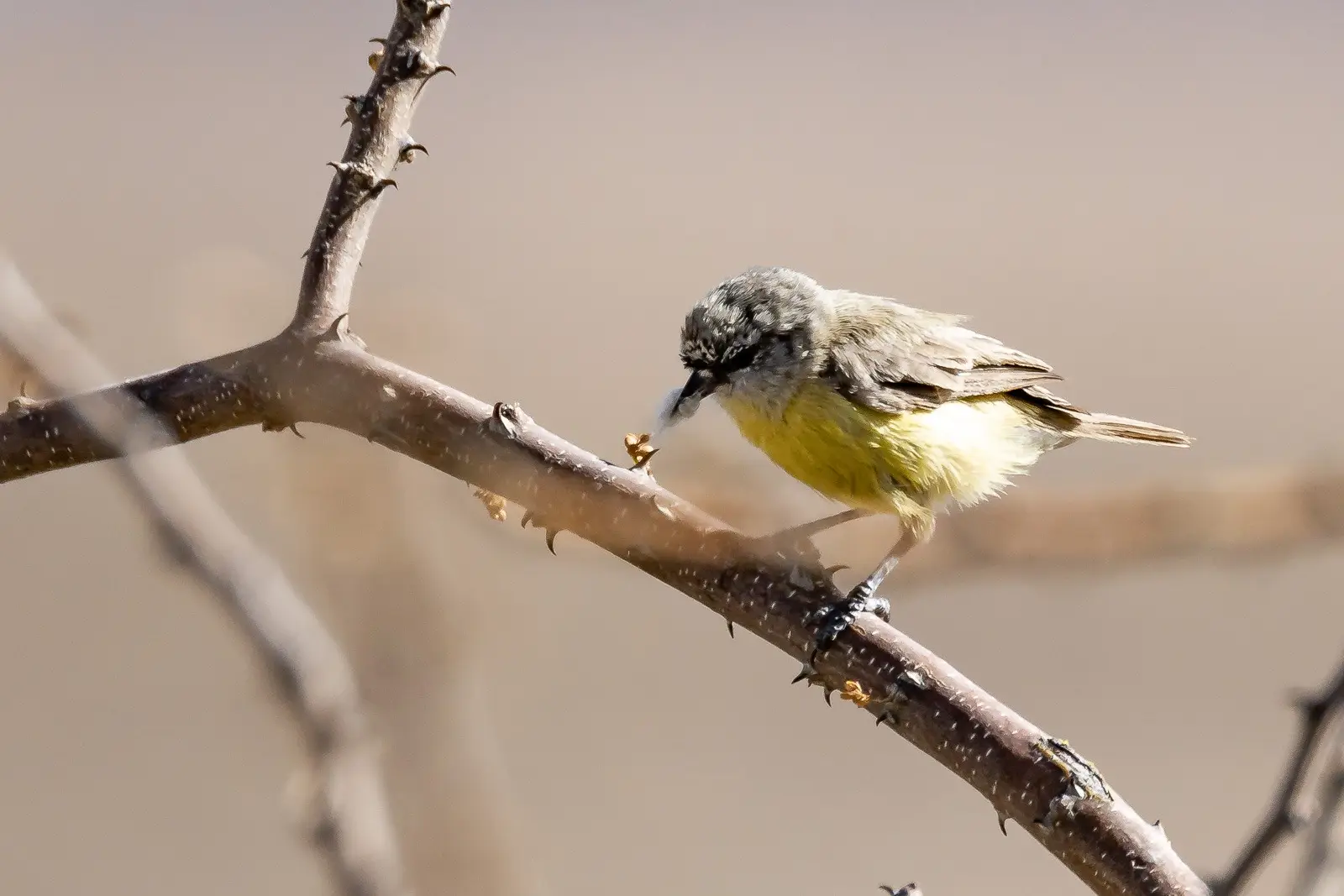
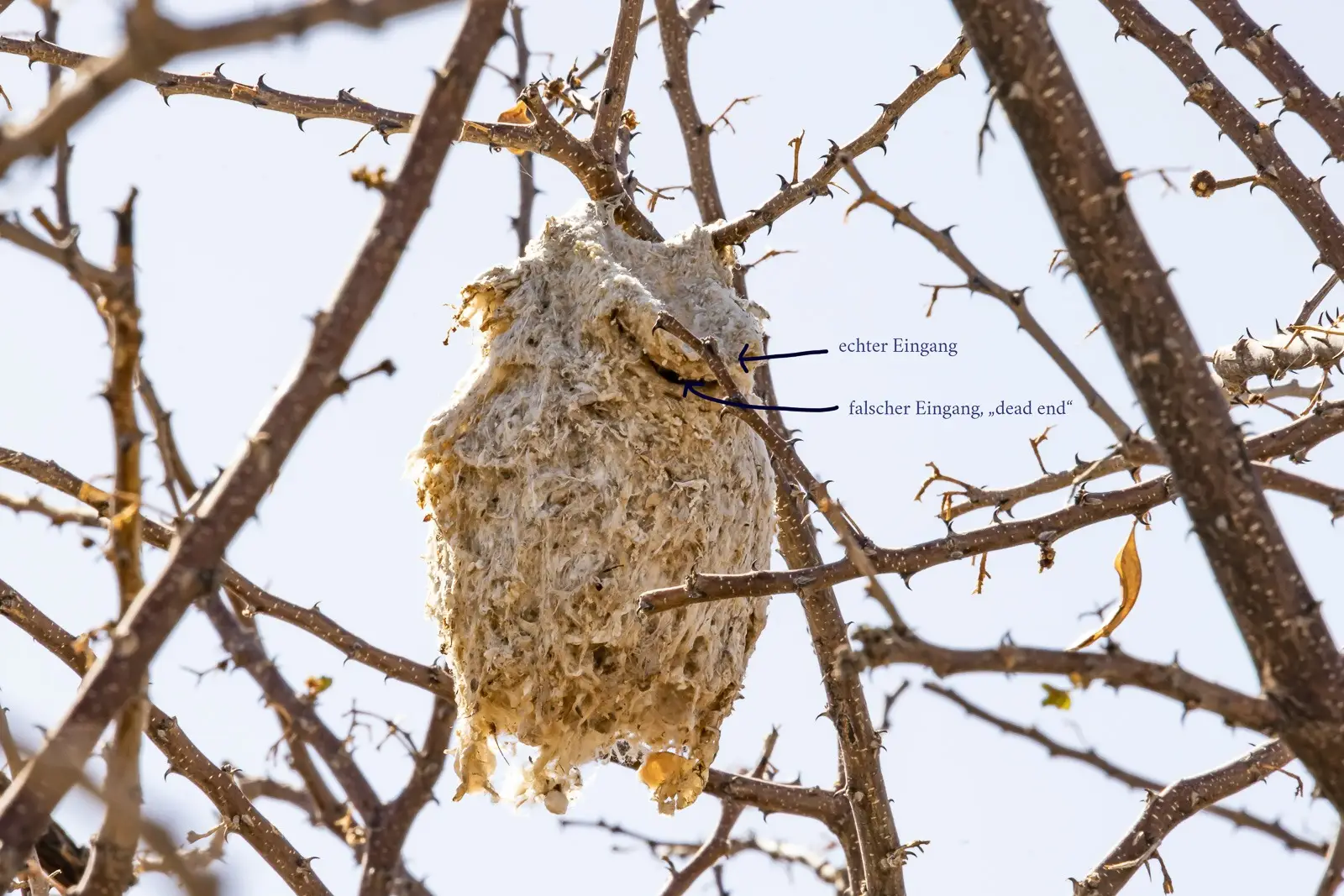
That was in 1997! I carefully picked a penduline tit’s nest out of an acacia and took it home. As the nest is spun from spider webs and hair fibres, it is structured like a flexible sack. The small hole is supposedly the entrance, or so one believes, but when you poke a finger in you soon end up in a one-way street and there is no way further … to the despair of the snakes hoping for a meal here. An elongated little tube that quickly collapses is the real entrance, through which the penduline tit can skilfully squeeze. The chicks of the previous brood like to join their parents and siblings in the evening, and up to 20 birds fit into the already stretched sack.
Sadly, I have not seen a Cape Penduline Tit on the LeafLove conservancy since 1997, and it seemed to me as if the drought had taken these talented architects from us too. In the Naukluft I discovered a single male last year … nothing else! These birds had vanished as if swallowed by the earth.


A large herd of giraffe, 17 of them, was moving ahead of us in the evening light when I suddenly heard that almost inaudible, fine, short whistle. Minutes later we stood in front of a flowering sweet thorn and could watch two Cape Penduline Tits picking tiny maggots out of the yellow blossoms.
Martina, as an expert, thought these would surely be the maggots of a fruit fly.
It was a pain to photograph them, because the Cape Penduline Tit never pauses … probably never 🙂
Seeing these animals here on the LeafLove conservancy fills me with hope and, admittedly, also with a little pride, because our nature-friendly principles pay off!
In the Zaris Mountains we then actually found another penduline tit that, to our astonishment, was just building a nest. Of course so deep in a hook-thorn acacia that we could not reach it at all … we would not have touched it anyway!

I would like to share three more special things from our hike, a natural-history stroll in the Zaris Mountains, with you:


By the way, in Namibia there is also the “normal” ground squirrel, Xerus inauris, which is usually smiled at as being tourist-friendly 🙂

As you can tell, we are having a wonderful time, kept natural, of course.
If you fancy it, you can join me in June for a natural-history trip, in July and August for a wildlife trip and in November for a birding tour … all to be found under this LINK 🙂
greetings from a midday rest during a safari,
albert
Matching tour: The farm Nomtsas is part of our birding safari Avifauna Namibia.
Last Updated on 6. October 2026 by Albert Voigts von Schütz


